Accreditation Challenges Usually Start Earlier Than the Site Visit
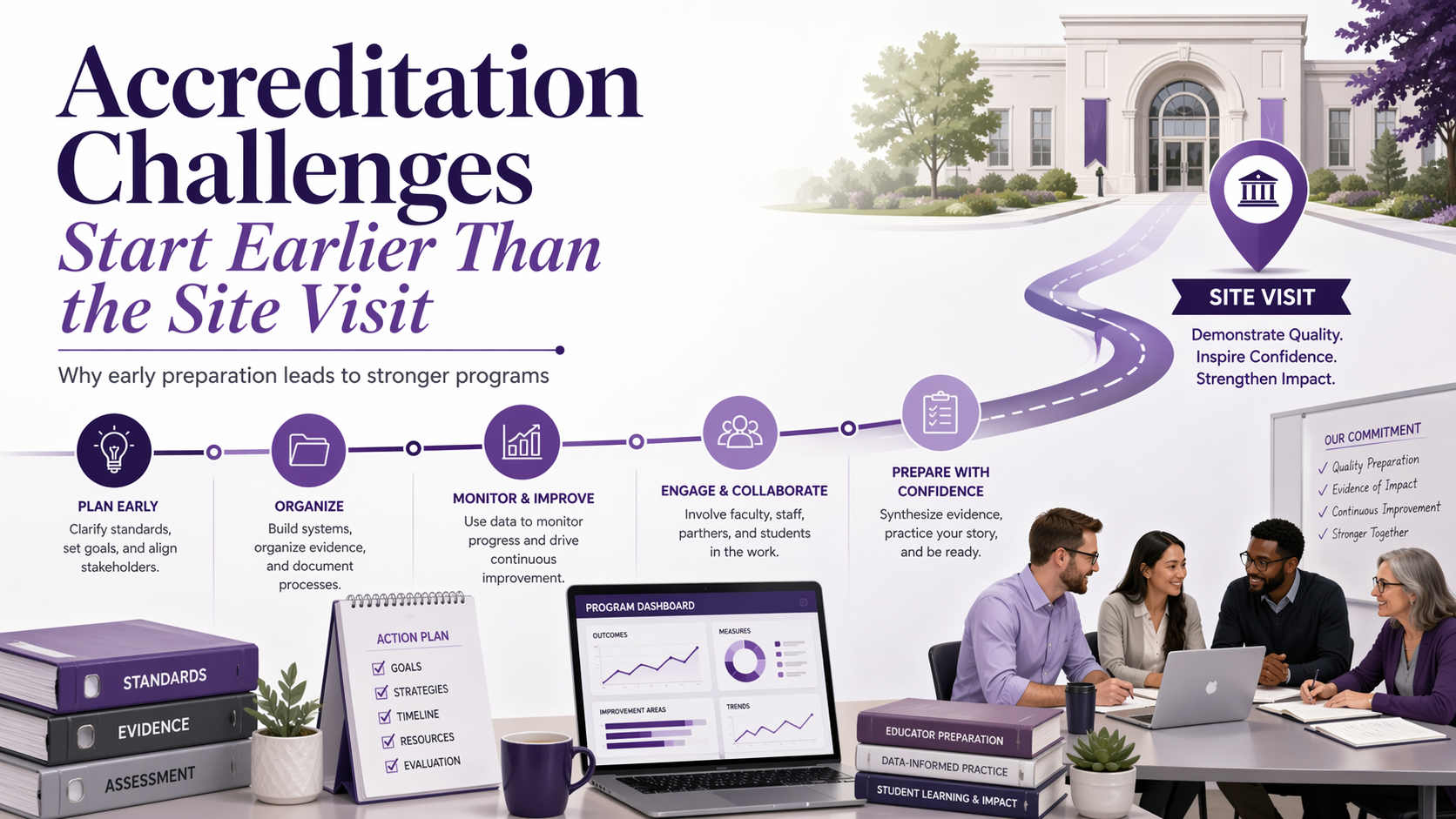
Most accreditation problems do not begin in the year of the site visit.
They begin earlier, when documentation lives in too many places. When mentor expectations are clear in conversation but not visible in evidence. When advisory boards meet, but the feedback loop is not well documented. When survey data exists, but no one has had time to connect it back to the standards.
By the time a CTC review team sees the problem, the issue can feel sudden. It usually is not.
In our work with California LEAs, the strongest programs are not the ones that never encounter challenges. They are the ones that notice issues early, name them honestly, and build systems that make the next review less dependent on memory, personality, or last-minute effort.
Accreditation readiness is not a binder-building exercise. At its best, it is a way of making program improvement visible.
Here are five common accreditation pressure points we see across Induction, Intern, Administrative Services, CTE, Adult Education, and other credentialing programs, along with the kind of response that tends to move programs from stress to stability.
1. The Program Is Supporting Candidates, But the Evidence Trail Is Uneven
This is one of the most common challenges in Teacher Induction.
A program may have thoughtful mentor-candidate conversations. Candidates may be reflecting on the CSTP. Mentors may be helping candidates connect inquiry work to classroom practice. But when the evidence is reviewed, the program may not be able to clearly show consistency across mentors, cohorts, candidate groups, or program years.
That does not mean the program is weak. It means the system is too dependent on informal practice.
In recent TIP data, we have seen candidate support ratings strengthen between mid-year and year-end when programs use the mid-year results as a real improvement checkpoint. The value of the mid-year survey is not just that it documents candidate experience. It gives the program time to respond while candidates are still in the program.
That matters for accreditation because it shows an active feedback loop. The program is not simply collecting data after the year is over. It is reviewing evidence, identifying where support may be uneven, and making adjustments before completion.
The accreditation question is not simply, “Are candidates being supported?”
The stronger question is, “Can the program demonstrate how it knows candidates are being supported, where support may be inconsistent, and what it did in response?”
That distinction matters.
2. Year 1 and Year 2 Candidates Do Not Always Need the Same Things
Aggregate results can be useful, but they can also hide the exact patterns a program most needs to see.
One pattern we have seen in our data is that Year 1 and Year 2 candidates often experience the program differently. Year 1 candidates may need more clarity around expectations, pacing, documentation, and how to navigate the induction process. Year 2 candidates may be more focused on the quality, usefulness, and efficiency of the support they receive.
That distinction can easily disappear when all candidates are combined into one overall result. A program-wide average may look stable while each group is actually asking for something different.
For accreditation purposes, this kind of disaggregation helps a program show that it understands candidate experience across the full arc of induction. It also helps the program avoid designing Year 2 as simply “more of Year 1.”
That is an important point. Year 2 candidates often know the system better, but that does not automatically mean they need less intentional support. They may need support that feels more targeted, more efficient, and more clearly connected to their classroom practice.
A strong program does not assume that the second year takes care of itself. It uses the data to ask whether Year 2 is functioning as a coherent professional growth experience or merely as a continuation of compliance tasks.
3. Morale Often Recovers by Year-End, But Year 2 Deserves Closer Attention
Across the data we have reviewed, morale often drops at mid-year and then recovers by year-end.
That pattern makes sense. Mid-year is when candidates and mentors are carrying a heavy combination of classroom demands, documentation, observations, inquiry work, and program requirements. A dip in morale does not necessarily indicate a failing program. It may reflect the predictable pressure point in the school year.
But there is an important complication: Year 2 candidates may show a deeper morale drop than Year 1 candidates.
That finding is worth paying attention to.
The common assumption is that Year 2 candidates need less support because they understand the program better. The data may suggest something different. Year 2 candidates may understand the requirements better, but they may also be more fatigued, more aware of the distance between compliance and meaningful growth, and more impatient with anything that does not feel directly useful to their classroom practice.
That does not mean Year 2 is failing. It means Year 2 may need to be designed differently.
For an accreditation narrative, this is a strong example of how program data can move beyond satisfaction reporting. It points toward a specific improvement question: how do we maintain rigor and evidence of growth in Year 2 while reducing unnecessary friction for candidates who are already carrying a full teaching load?
That is exactly the kind of question accreditation should help a program ask.
4. Stakeholder Feedback Is Collected, But Not Used in a Visible Cycle
Many programs can show that they survey candidates, mentors, completers, site administrators, advisory board members, or support providers.
Fewer can clearly show what happened next.
For CTC accreditation, the feedback itself is only part of the evidence. Programs also need to show how feedback was reviewed, what themes emerged, what decisions were made, and whether those decisions were revisited later.
This is especially important for Intern Programs, Administrative Services Credential programs, and Induction programs where multiple groups are responsible for candidate support.
If candidates identify a disconnect between coursework and field support, or mentors identify unclear expectations, or site administrators report inconsistent communication, the program needs more than a survey result. It needs a documented improvement cycle.
The evidence trail should make the program’s thinking visible.
That does not require a complicated process. It can be as simple as bringing survey findings to leadership or advisory meetings, identifying two or three priority questions, documenting the discussion, and recording what the program decided to adjust.
The key is that the feedback cannot disappear into a report that no one revisits.
5. Advisory Boards Exist, But Their Role Is Too Passive
An advisory board that meets only to receive updates is not the same as an advisory board that contributes to continuous improvement.
This is another place where programs can unintentionally under-document good work. They may have strong conversations with district leaders, mentors, university partners, HR staff, completers, site administrators, or community representatives, but the meeting records do not show how those conversations influenced the program.
A stronger advisory process does not need to be elaborate. It needs to be purposeful.
Programs can bring data to the group, identify a few questions for discussion, record the feedback, and then document how leadership responded. Over time, those minutes become evidence that stakeholders were not just informed, but meaningfully involved.
That is a much stronger accreditation story.
It also changes the purpose of the advisory board. Instead of functioning as a compliance structure, it becomes a place where data is interpreted, program assumptions are tested, and improvement decisions are strengthened by people who see the program from different angles.
What These Challenges Have in Common
The common thread is not failure. It is visibility.
Most programs are doing far more work than their evidence systems show. Candidates are being supported. Mentors are meeting. Directors are making adjustments. Advisory groups are offering feedback. Surveys are being administered.
But if the work is not documented, connected to standards, reviewed over time, and used to guide decisions, it becomes difficult to defend during accreditation.
That is why early preparation matters. Not because programs should live in a constant state of compliance anxiety, but because the best evidence is built gradually.
A strong accreditation system should help a program answer basic questions without scrambling:
What did candidates tell us?
What did mentors tell us?
Where did Year 1 and Year 2 candidates experience the program differently?
Where did morale dip, and where did it recover?
What changed because of the feedback?
How do we know whether the change helped?
Where are experiences consistent, and where do they differ by pathway, partner, role, or credential area?
Those questions are not separate from program improvement. They are the work of program improvement.
Sinclair Research Group works with California LEAs to build these systems before the pressure of a site visit becomes overwhelming. That includes standards-aligned surveys, disaggregated reporting, advisory board support, program evaluation, and evidence structures that make the improvement story easier to see.
Accreditation challenges are common. They do not have to become accreditation crises.
The strongest programs are not the ones with perfect data. They are the ones willing to look closely at what the data is telling them and respond before the problem hardens into a finding.